
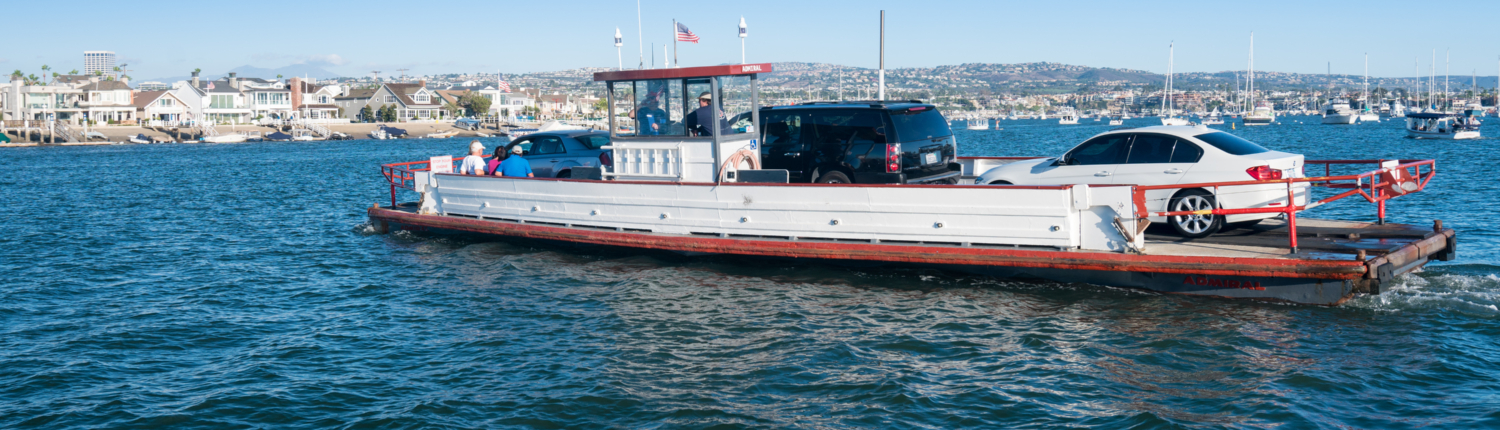
Could a solution to the Balboa Ferry’s future be at hand?
By Gary Sherwin – July 18, 2023
Source: Stu News Newport Could a solution to the Balboa Ferry’s future be at hand?

Gary Sherwin
For the last several months, I’ve been writing about the monumental challenges involving the beloved ferry’s status, given a state mandate for it to convert to electric engines, just like the demands faced by auto companies to change by 2035. For some reason, however, the ferry needs to swap out these engines by the end of 2024. If it doesn’t, it’s out of business.
The Balboa Ferry is a beloved local attraction and one of our most popular with visitors. It is an iconic part of our city and is featured in travel outlets globally as one of the best things to do while in Newport Beach. Losing it would be a tragedy.
California has been leading the way nationally in the development of clean energy technology. It was decided that if you have a motor in just about anything, including leaf blowers, you will need to move to electric. And you apparently need to do it now.
Of course, that isn’t easy. The difficulty with all of this from the beginning has not been a reluctance to change the engines at the ferry; it has been the lack of technology to convert old wooden barges, which is really what the ferry is, and put in electric motors. It’s not like you can drop into Home Depot and pick one up. It just doesn’t exist.
And perhaps the biggest issue of all is the huge price tag to make this unfunded mandate happen, and those costs are skyrocketing.
However, there has been some good news lately on all of that, although the ferry is far from out of the woods.
Last week, Assemblywoman Diane Dixon met with the California Air Resource Board (CARB) Executive Officer, Dr. Steven Cliff, to move the issue forward. CARB is the regulatory agency overseeing the compliance, and Dixon indicated that they are engaged on the issue and said that if the Beek Family, which owns and operates the ferry, is committed to pursuing solutions to move to compliance with the ferry, they would not shut it down when the deadline comes next year.
CARB said they have heard plenty from the community and understand the importance of the ferry to Newport Beach. They want to work with them on grants and other ways to make the change possible.
But dealing with a huge government entity like CARB, which has 1,700 employees and a budget of $2.7 billion, is not easy. There is tons of paperwork, and Seymour Beek, who runs the ferry, has had his nephew Joe Beek, an attorney, take the lead. The details of filling out numerous grants are mind-numbing.
Another positive sign is the expected contract signing this week with San Diego-based Aurora Marine Design and Green Yachts, which will work together to see if a conversion on the vessels is even realistic.
The Beeks are paying $100,000 for this study themselves, and we’ll know by Christmas if the wooden boats can be retrofitted.
In the meantime, the expected costs to make the conversion happen have now gone from an estimated $5 million to nearly $11 million, some of which may be covered by grants. The rest will likely have to come from a community-based fundraising effort since the family-owned ferry probably can’t do that on its own. Nothing is cheap these days, especially a complex project like this one.
The goal is to keep the wooden ferries “as is,” rather than building all new ones, perhaps in another material like aluminum which certainly changes the historic charm of the attraction.
According to Joe Beek, it is a bit like remodeling a house. Some contractors will tell you that it might be cheaper to demolish an old place and start over, which could be the case for the ferry if a technical solution can’t be found.
The other issue is Coast Guard approval. They need to sign off once the conversion takes place and if they don’t feel comfortable with electric engines on old wooden boats, then they will stop operations despite CARB’s approval.
Aurora’s first goal is to see if the conversion can occur and what that looks like or if new boats need to be built. After that, phase two begins, and the Beeks will need a solution because that’s when the big costs kick in. Even with grants, some things will not be covered, like sales tax on materials which are expected to run as high as $150,000, according to Joe Beek.
While some grants will provide perhaps $1.5 million for equipment purchases, they also don’t cover the management costs of the project. The ferry has only one full-time management employee and Joe Beek was roped into the project by Seymour and is volunteering his time as a devoted family member. This is a huge burden on a very small family business.
CARB has said that the ferry does qualify for a deadline extension which they can apply for two of the ferries that can last up to two years. They may continue to apply for additional extensions if they are working in good faith on conversion, which the Beeks have said they will do.
One of the often-discussed solutions to the ferry dilemma by local wags is just to increase the ferry’s fares which are an amazing $2 per passenger, admittedly a pretty good deal. However, surprisingly, the ferry doesn’t have control over its own fares. The California Public Utility Commission decides these things, and they are reluctant to do that since they opt to keep transportation fares as low as possible. That squeezes the ferry since they can’t control their revenue despite rising costs.
So, the good news is that CARB sees the value of the ferry and has heard the public outcry about keeping it afloat. That’s a tribute to extensive media coverage and an online petition that generated thousands of signatures.
In the meantime, Joe Beek is buried in CARB grant paperwork and navigating the complex grant approval process. Luckily, he is an attorney and is somewhat used to this, but to a mere mortal, it would be a near-impossible challenge. State bureaucracy is never easy to navigate.
The really important point to note is that absolutely none of this makes business sense. For the ferry to shell out $100,000 to hire a marine design company, that is about one year’s operating profit. It’s a small business that generates $2 million gross on a good year. Many ferry owners would have just thrown in the towel and called it a day. Most businesspeople wouldn’t blame them.
Yet the Beeks remain committed and are working to find a solution, even if it is expensive and they will never recover the costs they are sinking into this.
The Beeks are devoted to this ferry and doing whatever they can to keep it operating. We should all be thankful that they are, as should everyone in Newport Beach who cherishes this important community asset.
Gary Sherwin is President & CEO of Visit Newport Beach and Newport Beach & Company.
Source: Stu News Newport Could a solution to the Balboa Ferry’s future be at hand?

By Sandra Barrera, Orange County Register
Remember the waterfront mansion on Newport Beach’s Balboa Peninsula that generated international buzz with a YouTube video that spoofed Cali Swag District’s viral dance hit “Teach Me How to Dougie?”
The video for “Teach Me How to Duffy” helped sell the house for $35.008 million – about 22.2% less than the $44.995 million asking price when it hit the market in Oct. 2018.
Even so, the house, which sold on Aug. 28, set a record.
The sale is highest-priced home to ever sell in Newport Harbor, said Tim Smith of Coldwell Banker, the listing agent. The record previously was held by the home of actor Nicolas Cage, which sold in 2008 for $35 million.
But Smith expected as much.
The house was designed by Robert Sinclair, built by Patterson Custom Homes and finished by Blackband Design.
“The type of buyers that buy these (homes), and the buyer that bought this isn’t going to go through the five-year entitlement process and build a house,” he said. “They’d rather have something turn-key and they’re OK paying for it. That’s why we had more than one offer.”
The towering 14,000-square-foot, five-bedroom house presented as party central in the “Duffy” video stretches across three lots, with 90 feet of bay frontage. It boasts a theater, sauna, solar system with three Tesla batteries, 57-foot-long pool with underwater speakers and a private beach with a dock.
“You can park eight Duffies on the dock just for starters,” goes the song in a viral video that starred Smoove da General and Mr. Swag of Cali Swag District and a variety of young Instagram influencers, models and dancers.
Other highlights include a floating underlit staircase illuminated from above by a large skylight, 16-foot stone fireplace and 1,100-gallon aquarium.
There’s also a five-car garage with EV plug-ins.
“The job of the ‘Duffy’ film was to let everybody in real estate, especially, know about this house,” Smith said. “It did its job and because of that it gave us exposure that we never would have got.”
More than half of the showings, he added, were people from outside of the area and saw the film first.
Tara Foster Shapiro of Pacific Sotheby’s International Realty represented the buyer, whom she wouldn’t identify.
But she said, “Their interest in the house stemmed from their admiration in architect Rob Sinclair’s work. That is why we toured the property.”
Photo Credit: Tim Smith, Coldwell Banker
Visitors to Newport Beach today might know the coastal Southern California city from “The Real Housewives,” “The O.C.” and “Arrested Development,” all of which were set amid its rolling green hills and picture-perfect beaches. But I had come to Newport Beach to commune with the stars of Old Hollywood, who began staking their claim to this idyllic spot just one hour south of Los Angeles during the silent film era.
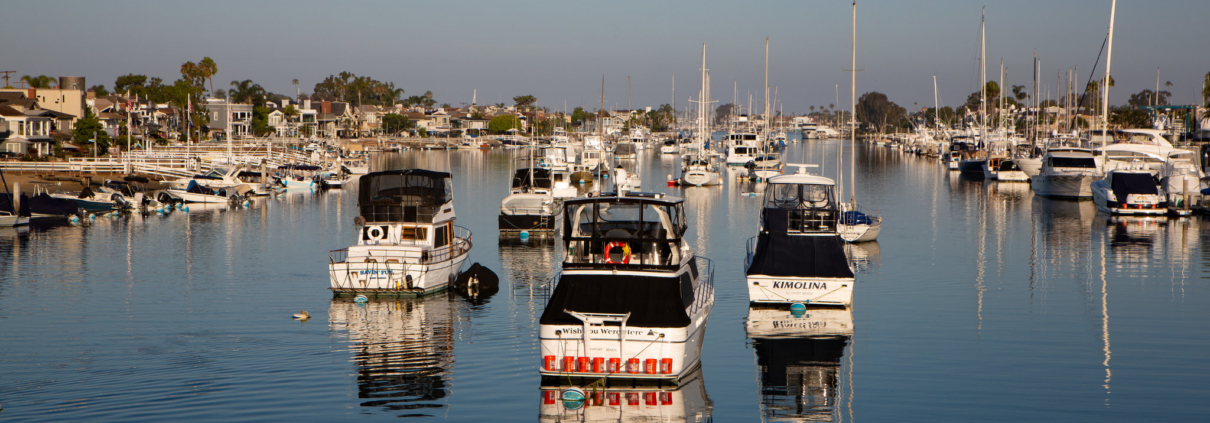
In the Golden Age of Hollywood, Newport Beach’s lure was not so much its land, dotted as it was with big-band ballrooms and smoke-filled cocktail bars. It was its water, and specifically the sprawling recreational harbor where the stars docked their yachts and sailboats.
Continue reading at The New York Times…
Photo Credit: Beth Coller/The New York Times
After taking over management of the moorings from the Orange County Sheriff’s Department Harbor Patrol last summer, Harbormaster Dennis Durgan provided a “Year in Review” summary for the Newport Beach Harbor Commission on Wednesday.
Commissioners asked a few questions and expressed support for the work the Harbormaster team has done over the past 15 months.
“I think your numbers speak for themselves,” Commissioner John Drayton said. “You’ve really done a fantastic job.”
Among many other reported statistics, between July 1, 2017, and June 30, the Harbormaster team has recorded 2,144 general assists, 962 wake or speed advisements, 662 mooring checks, 253 pier/dock/bridge issues (includes jumping, fishing, time limits, and gangway issues), and 19 emergency calls to either OCSD Harbor Patrol or NB police.

Share this entry