
Good ‘Seamaritan’ Sets a Course to a Trash-Free Harbor
Source: Newport Beach Independent Good Seamaritan sets a Course to a Trash Free Harbor
Having sold four of the five highest-priced Newport Harbor waterfront homes during his 24-year sales career, Coldwell-Banker realtor Tim Smith has been “cleaning up,” but not in the way you might think.
An avid fisherman (he owns a Boston Whaler Realm 38’) and Dover Shores resident who “loves this harbor,” Smith has been focused on how he can help make the bay as clean as possible.
The answer came from his firm’s marketing partner, Greg Blake, who asked, “What if we had a boat and a crew to clean the bay?”
It was textbook service marketing, where company efforts both promote good for the community as a whole, while hopefully generating the attention of potential clients.
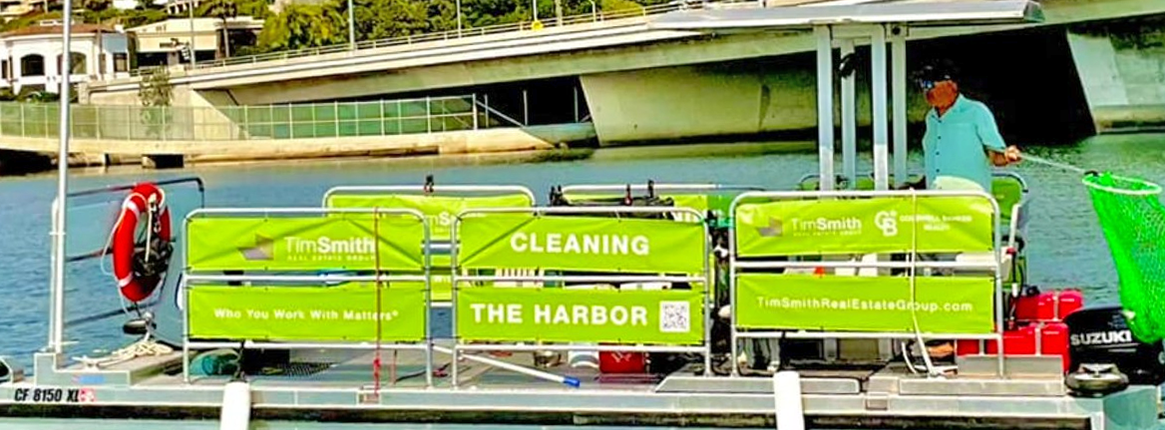
To that end, Smith ordered a “skimmer,” an all-aluminum, flat-decked, outboard- powered catamaran workboat designed by Elastec Boats of Carmi, IL to suck up floating trash. Fitted out, the vessel cost $120,000 and took a year to build. The Smith Team christened her “The Good Seamaritan.”
She has now been in service for just over three months under the command of local Capt. Robert Sloan. Although he currently works but three days a week, Sloan and the “Good Seamaritan” have collected and ferried thousands of pounds of trash to an offload zone at Marina Park.

Unless one gets down and dirty, it’s hard to realize just what floats above and just under the surface of bay water.
“The most common things I pull out are plastic water bottles, cups and lids, tennis shoes, large wood logs, plus other wooden objects and polypropylene line,” shared the skipper.
On one outing, Sloan snagged a 25-foot waterlogged log, which he had to tow to Marina Park. On his most prolific day to date, the skipper offloaded 550 pounds of trash. He uses boat hooks and a variety of nets that he has purchased to capture the flotsam and has become “good at driving and collecting” without having to stop. Except for that log.
“The more extreme the tides, the more extreme the trash,” Sloan observes. Depending on those tides, the trash seems to collect in certain areas — which he knows well from having skippered a variety of boats for several companies in the harbor since 1985. In terms of collecting, Sloan generally patrols between the Newport Aquatic Center and the harbor jetties.
Although most often crewing and collecting by himself, he is never alone, for his long time partner, Xena, always joins him. Xena is a giant mutt that fits that salty description, “old sea dog.” Sloan, however, is looking for human volunteers to help spot and haul in the trash.
Skipper Sloan doesn’t always concentrate on flotsam; he’ll often stop at various beaches, docks and residences along the route to sweep or rake up the jetsam. Although he now gets paid for his efforts, Sloan has made it a practice for a couple of decades to scoop up anything that pollutes the waters. He is well known along the waterfront for his work.
In the long haul, “Good Seamaritan” may become one of the more famous boats afloat in Newport, even though it will have a trashy reputation—but in this case, that’s a good thing.
Source: Newport Beach Independent Good Seamaritan sets a Course to a Trash Free Harbor
By Laylan Connelly – Orange County Register
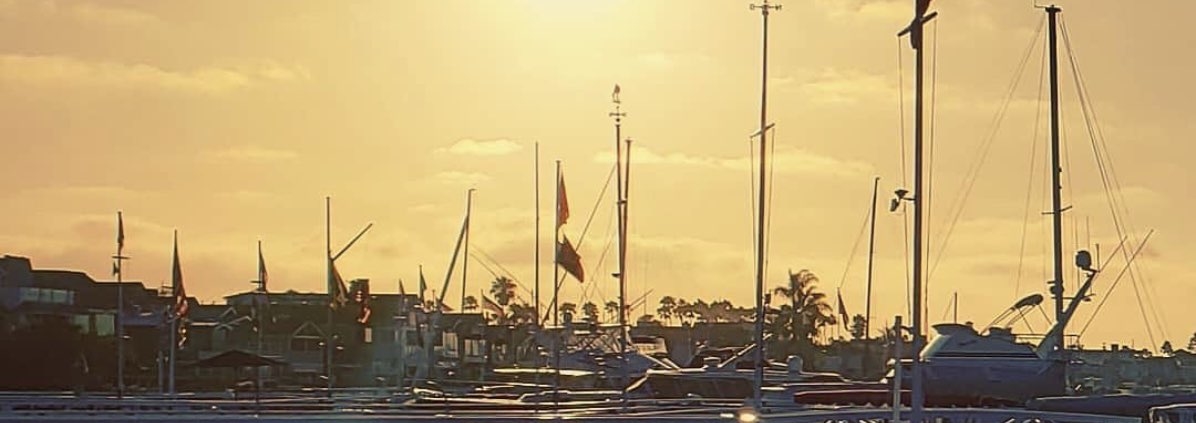
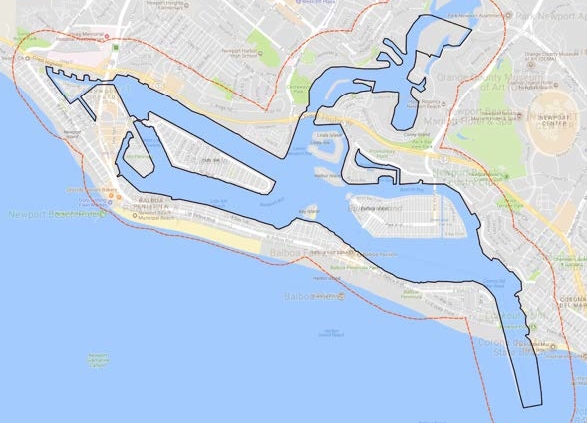
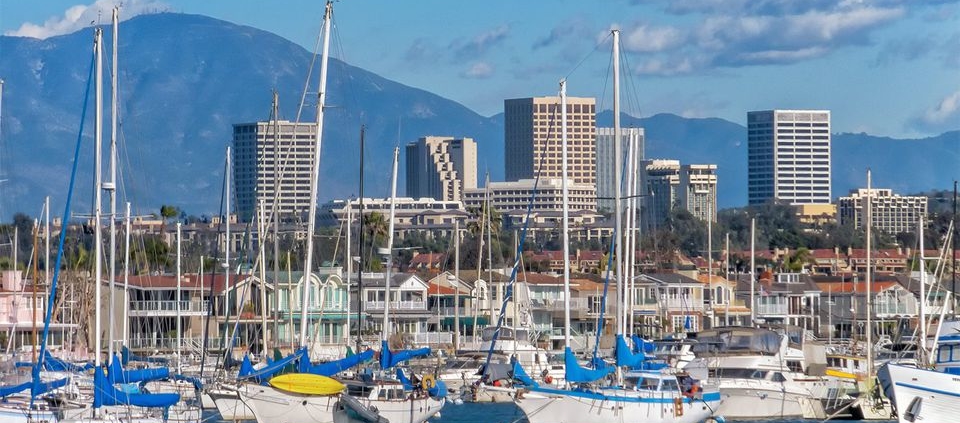
Officials have secured $8.3 million to dredge Newport Harbor in the $14 billion Infrastructure Investment and Jobs Act, but sand replenishment projects for two stretches of Orange County coastline were not included.
U.S. Rep. Michelle Steel said dredging of Newport Beach’s harbor is long overdue in her announcement Wednesday, Jan. 19, about the federal funding, but also stressed the need for added sand along the coastline. Funding for the Surfside-Sunset Replenishment Project, which would seed beaches through Huntington Beach south to Newport Beach will have to hope for final approval from another Congressional appropriations bill, the timeline of which has been unclear.
So is the San Clemente Shoreline Project, which would replenish beaches in the southern city, including improving the buffer of shoreline along a key coastal rail line.
Both projects have been stalled for years, awaiting funding for U.S. Army Corps of Engineers to do the replenishments that help create a beach buffer that would protect roads, homes and infrastructure from ocean flooding, as well as keep beaches – one of the region’s major tourism draws – from disappearing.
In 1962, Congress passed the Rivers and Harbors Act, which required the Army Corps of Engineers to address the impacts of the constructed flood control structures on the sand deposits that should be happening naturally along shorelines.
The $23 million Surfside-Sunset project – $15.5 million in federal money and $7.63 from local agencies – would add 1.75 million cubic yards of sand to Surfside, which would then be pushed down the coast by ocean currents and waves, spreading it 12 miles south to Newport Beach.
The last time sand was added was 2010 – previously the replenishment happened every five to seven years.
“There is more work to do, and I will continue to demand action from the administration and the Army Corps to fully fund the Surfside-Sunset Replenishment Project because we are one natural disaster away from devastation,” Steel said in a statement.
San Clemente has been waiting about two decades for its big replenishment project. The city two years ago received a boost in the amount of $500,000 in federal funding for the design phase.
With no beach left, a wave crashes against the rocks and stairs just below the railroad tracks at North Beach in San Clemente on Wednesday, October 20, 2021.(Photo by Mark Rightmire, Orange County Register/SCNG)
The project would add 251,000 cubic yards of sand from Linda Lane beach to T-Street beach south of the pier. The sand has shrunk so much there in recent years, city leaders have discussed the possibly of moving San Clemente’s Marine Safety Headquarters off the beach. When big surf hits, the surf laps onto the railroad tracks.
About $9.3 million was requested in the bipartisan infrastructure bill by U.S. Rep. Mike Levin for the San Clemente Shoreline Project.
Levin helped secure $30.5 million in federal funding for the Encinitas-Solana Beach Coastal Storm Damage Reduction Project and $1.8 million for the Oceanside Special Shoreline Study, his office announced Wednesday.
The Encinitas-Solana Beach project involves placing 700,000 cubic yards of sand along 7,200 feet of beach in Solana Beach and 340,000 cubic yards of sand along 7,800 feet of beach in Encinitas.
The Oceanside shoreline study will create a plan to mitigate erosion and other effects from the construction of Camp Pendleton Harbor and will restore beach conditions along the affected shores to the conditions that existed before its development.
Levin’s office said he is also “continuing to fight to finalize federal funding for the San Clemente Shoreline Project.”

RIGHT ON ROBERT!
The Sloan’s and Giddings’ have been friends for close to seven decades, and sailed the area for many years before that. Our parents even built a boat together in the 50’s, and our mothers were classmates at NHHS.
As a kid, I was lucky enough to have met him in my Lahaina, when he and his dad were doing a gear delivery for Trans-pac. Coincidentally, we had no idea about the family connection, but became fast friends and have remained so ever since.
They just don’t make ’em better than Rob. He’s true blue, a great sailor, and a super guy, I’m proud to call (as we say in Hawai’i), one bruddah from one noddah moddah.
Aloha Nui