

Report — Abandoned and Derelict Vessels
I hope the following information, reflecting our efforts on abandoned and derelict vessels in Newport Harbor, is helpful.
Since I assumed my role as Harbormaster, the City has taken decisive action to remove numerous abandoned or voluntarily surrendered vessels from Newport Harbor. These removals are vital for safety, navigation, and environmental protection. However, the process to secure legal authority for the removal and destruction of a privately owned vessel is necessarily lengthy and complex. To protect the City’s interests, we strictly adhere to all established legal procedures. In one recent example, the process required over two years, the formal arrest of a vessel, the engagement of outside maritime legal counsel, and two Federal Court actions.
Here’s a summary of all the abandoned or surrendered boats removed from Newport Harbor since I became Harbormaster:

Although the removal numbers demonstrate that we have made meaningful progress—often at significant cost to taxpayers—we continue to see vessels enter Newport Harbor that are likely to be abandoned or surrendered in the future. The good news is that Newport Beach has the laws and resources in place to address these situations before they become major hazards. By contrast, I recently observed six sunken vessels left languishing on the breakwater at the entrance to San Diego Harbor, where the lack of adequate legal tools and resources has allowed serious safety and water-quality risks to persist and worsen.
The Harbor Department has effectively leveraged the State of California’s Surrendered and Abandoned Vessel Exchange (SAVE) Grant to remove unsafe, unsightly, and environmentally hazardous vessels from Newport Harbor. In each of the last two grant cycles, the City received $175,000 and fully expended those funds.
Based on this strong performance, the Department was encouraged to apply for $250,000 in the upcoming grant cycle. However, statewide budget reductions reduced the overall SAVE program allocation to $1 million and capped individual awards at 10 percent of that total. As a result, the City received the maximum available award of $100,000 for the grant cycle beginning January 1, 2026, and running through September 30, 2027.

At present, six known abandoned vessels require destruction at a cost exceeding $100,000, which will fully consume the grant funds at the outset of the cycle. Accordingly, through the City’s Program Enhancement Request process, I have requested $150,000 in additional City funding specifically to address the shortfall for vessel destruction. If approved, these funds would become available on July 1, 2026.
Given the reduced availability of state funding and the ongoing need to protect public safety, navigation, and water quality in the harbor, supplemental City funding is essential to sustain this critical public-service program. Without it, vessels that are inevitably abandoned or surrendered may remain in the harbor longer than is acceptable, creating avoidable risks and environmental impacts. If the City’s funding request is not approved, or if demand increases significantly, I will continue to seek alternative funding sources to close any gaps.
I appreciate your interest in Newport Harbor’s health and safety.
Warm regards,
Paul Blank
Harbormaster
Harbor Department
City of Newport Beach
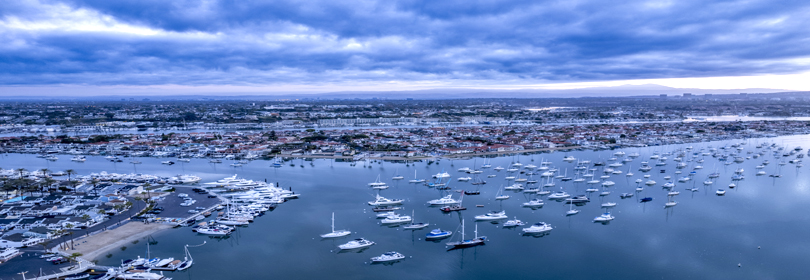
This week I’d like to recognize critical, often unsung members of our City team who perform a vital service during rainstorms: the Utilities Department crews that pump storm water and operate the tide valves on Balboa Island and the Peninsula.
The valves, which were built in the 1970s to replace a system from the early 1900s, are necessary to prevent flooding in low-lying areas. They are manually operated, and need to be closed during high tides to prevent seawater from flooding the streets. Once the tide recedes, crews reopen the valves — nearly 90 in total — to allow water to flow from streets to the bay.
In some ways, on some days, we all live trashy lives.
Even an inadvertently dropped gum wrapper via the forces of gravity, wind, and water runoff finds itself in company with all manner of discarded detritus heading to our oceans and beaches.
Trash is strictly a human byproduct. Just walk Newport’s sands after a crowded summer day. Or stand by the outflow of the Santa Ana River, or the entrance to the Upper Bay estuary post-storm to witness the “flood” of trash tangled in broken foliage washed downstream, to either float offshore, rest on our beaches or become locked in the life-giving vegetation of the Back Bay.
In some ways, on some days, we all live trashy lives.
Even an inadvertently dropped gum wrapper via the forces of gravity, wind, and water runoff finds itself in company with all manner of discarded detritus heading to our oceans and beaches.
Trash is strictly a human byproduct. Just walk Newport’s sands after a crowded summer day. Or stand by the outflow of the Santa Ana River, or the entrance to the Upper Bay estuary post-storm to witness the “flood” of trash tangled in broken foliage washed downstream, to either float offshore, rest on our beaches or become locked in the life-giving vegetation of the Back Bay.

Share this entry